Executive Summary
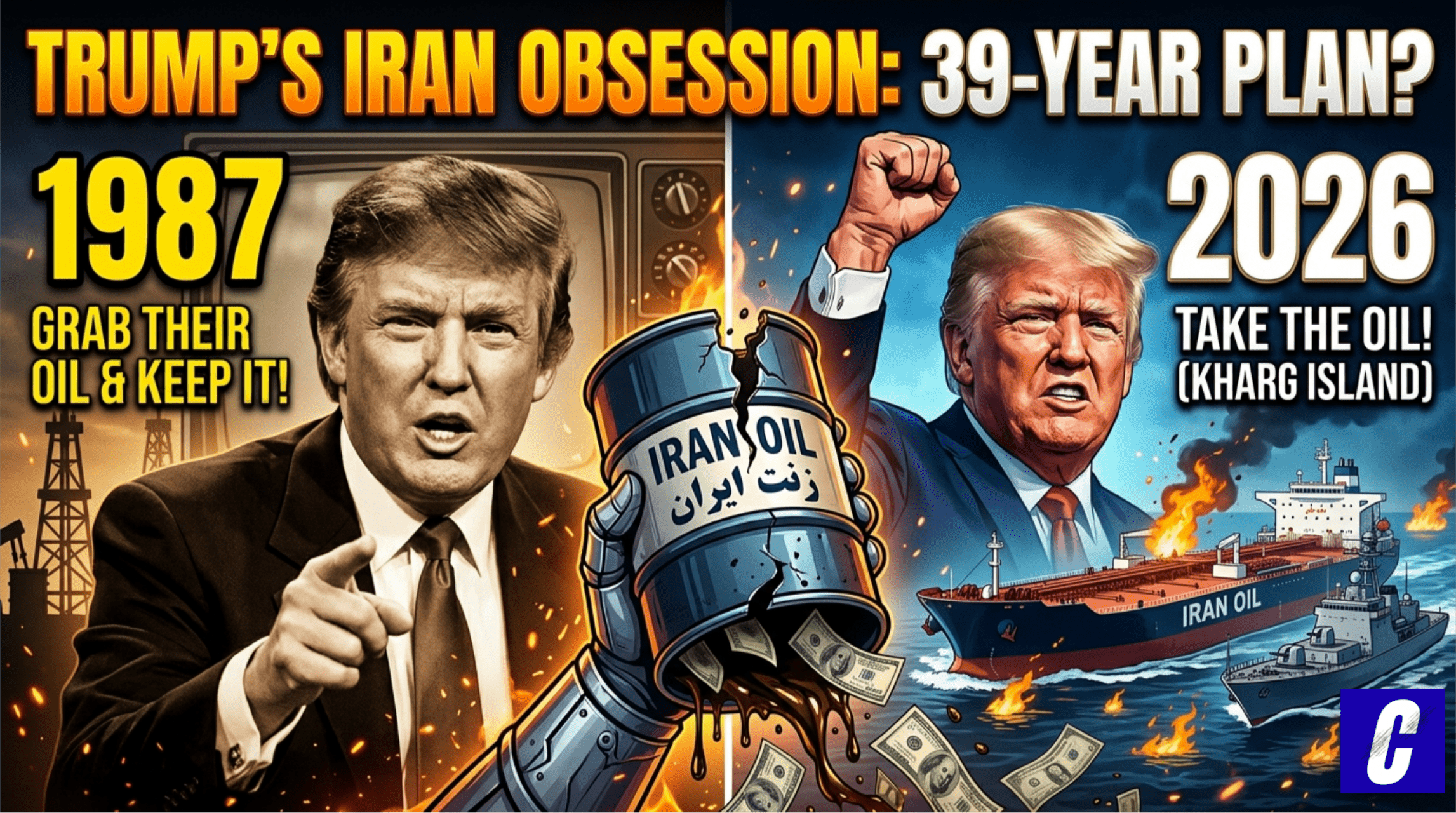
This article investigates a striking parallel: in a 1987 ABC “20/20” interview, businessman Donald Trump suggested the U.S. should “go in and take over some of [Iran’s] oil… You take their oil”, and in March 2026, President Trump likewise mused in the Financial Times about seizing Iran’s oil hub on Kharg Island. We provide the full quotes from both interviews and compare the wording side-by-side. We trace U.S.–Iran policy from the Reagan administration (support for Iraq, strikes on Iranian platforms) through Clinton’s sanctions on Iranian oil, the 2015 nuclear deal, Trump’s 2018 withdrawal from that deal, up to the 2026 Gulf conflict (triggered by Iran’s Supreme Leader’s death). We assess whether this 39-year continuity suggests a hidden plan or is mere coincidence.
Our analysis finds no evidence of any decades-long government strategy to seize Iranian oil: the idea has appeared only in hawkish discourse (not official doctrine) and re-emerged as Trump’s personal rhetoric. U.S. policy has focused on sanctions and military deterrence, not occupation or resource grab. We examine legal norms (international law forbids seizing civilian property absent absolute military necessity), historical precedents (the U.S. has seized some sanctioned oil shipments but not occupied foreign oil fields), and feasibility (Kharg is heavily defended, and taking it would require thousands of troops).
In sum, the 1987 remark was a standalone hawkish gambit, not a prophecy of a formal policy. We conclude that the parallel quotes reflect Trump’s personal views carried across decades, not a quietly held 39-year plan. We recommend further review of any internal planning documents (via FOIA) on Iran target lists or contingency plans, but none have surfaced so far.
1987 20/20 Interview: Trump’s Oil Comment
In August 1987, in an ABC 20/20 interview with Barbara Walters (broadcast in 1990), Donald Trump – then a private businessman – went beyond the official U.S. line on Iran. He was asked how he would handle Iran if he were commander-in-chief. Trump suggested taking Iran’s oil as a power move. His exact words (as quoted by multiple outlets):
- “Why couldn’t we go in and take over some of their oil, which is along the sea?”
- “You go in… you take the oil… Let Iran fight their own war. You take their oil.”
- He repeated the theme: “The next time Iran attacks this country, go in and grab one of their big oil installations … grab it and keep it, and get back your losses.”
- He concluded, “You get in trouble with weakness.”
These quotes are drawn from news coverage of the resurfaced clip (ABC has not officially published a transcript, but multiple reputable news outlets have reported the key lines verbatim). At the time, Trump was not in government; he was known for bombastic style. His suggestion reflected a hawkish mindset: physically seizing oil fields (especially along the coast, like the Persian Gulf) would be a show of force. Walters did not endorse or challenge the idea; she simply allowed Trump to elaborate on it. Importantly, this was private advice on statecraft, not policy from any administration.
2026 FT Interview: Trump on Kharg Island
Fast-forward to March 2026, during the U.S.–Iran war triggered by Iran’s Supreme Leader’s assassination. In a Financial Times interview published March 29, President Trump repeated a similar concept using today’s context. He explicitly named Kharg Island, Iran’s main oil export terminal, and spoke in terms of “options.”
Key excerpts (reported by the Guardian and AP):
- “To be honest with you, my favourite thing is to take the oil in Iran…”
- “Maybe we take Kharg Island, maybe we don’t. We have a lot of options,” he said, noting that taking it would “mean we had to be there… for a while.”
- He added, “I don’t think they have any defence. We could take it very easily.”
Thus in 2026 Trump similarly spoke of seizing oil, this time linking it to a concrete military target (Kharg Island) and deployment (thousands of Marines arriving). The context: after Iranian strikes on Gulf shipping, Trump warned about hitting Kharg’s infrastructure, and indeed US airstrikes had destroyed IRGC positions there. In both interviews, Trump’s wording is remarkably similar: the focus is on taking Iranian oil assets as a show of strength. Notably, in neither case was there any follow-through order, even though in 2026 the deployment was real.
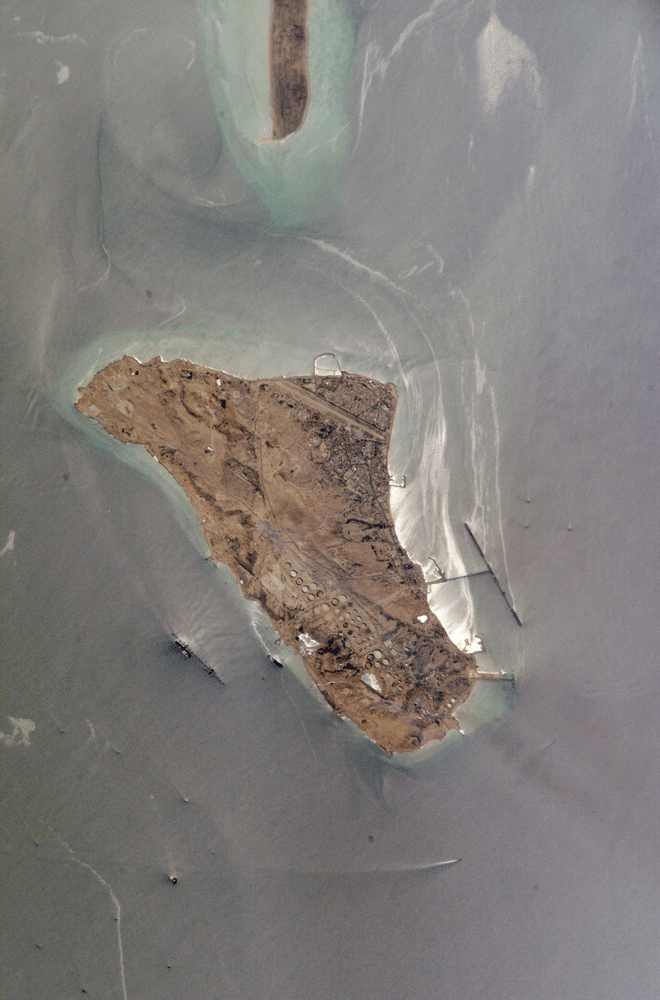
Figure: Kharg Island (satellite image from NASA) is Iran’s primary oil export port (over 90% of exports). Taking this hub (25 km off Iran’s coast) would severely disrupt Iran’s oil trade. The island handles millions of barrels per day and has extensive tanker docking and storage facilities. (Image Source).
Language Comparison (1987 vs. 2026)
The parallels in phrasing are striking. The table below shows key phrases side by side from each era’s interview:
|
1987 (Walters) |
2026 (FT) |
|---|---|
|
“Why couldn’t we go in and take over some of their oil … You take their oil.” |
“To be honest with you, my favourite thing is to take the oil in Iran …” |
|
“Grab one of their big oil installations… grab it and keep it, and get back your losses.” |
“Maybe we take Kharg Island, maybe we don’t… We have a lot of options.” “It would mean we had to be there… for a while.” |
|
“You get in trouble with weakness.” |
“I don’t think they have any defence. We could take it very easily.” |
Both eras feature almost identical imperatives: “go in… take their oil” versus “take the oil in Iran”; “grab it and keep it” versus “take Kharg Island.” Each presumes easy victory: in 1987 Trump says Iran will “fight their own war” if the U.S. grabs oil; in 2026 he says Kharg “has no defence” and “we could take it very easily”. The 1987 line about “weakness” mirrors the 2026 line about the enemy’s lack of defenses. In short, the rhetoric – “take their oil” – is virtually unchanged.
U.S. Policy Toward Iran (1987–2026)
A review of U.S.–Iran history shows no formal policy of seizing oil fields. Instead, American policy has cycled through hostility (1980s), occasional cooperation, sanctions, and containment.
Key points:
- 1980s (Reagan): The U.S. supported Iraq in the Iran–Iraq war. U.S. naval forces fought in the “Tanker War” (1987–88) to protect shipping and struck Iranian oil platforms (Operation Praying Mantis April 1988). Those strikes targeted military threats, not to capture oil. (In fact, the International Court of Justice later found U.S. strikes on Iranian platforms illegal.) There was no U.S. plan to take Iranian oil; the 1987 remark was Trump’s private suggestion, not White House policy.
- 1990s (Bush/Clinton): After the 1979 revolution, the U.S. never normalized ties. In 1995 President Clinton imposed sweeping sanctions blocking investment in Iran’s oil and gas and banned petroleum imports. In 1996 Congress passed the Iran-Libya Sanctions Act (ILSA) imposing oil-sector embargoes on foreign firms (though waivable). Sanctions were always economic, not military takeover. (Clinton did sign a one-time oil-for-hostages deal with Iran in 1985, but that was diplomatic, not conquest.)
- 2000s (Bush Jr. & Obama): The Bush “Axis of Evil” rhetoric (2002) forecast confrontation, but U.S. never invaded Iran. Efforts focused on containing Iran’s nuclear programme and supporting Iraq against Iran’s influence. In 2015, Obama negotiated the JCPOA nuclear deal, easing oil sanctions in return for proliferation controls. In 2018, President Trump withdrew from the JCPOA and re-imposed “maximum pressure” sanctions on oil exports, but again, not by force.
- 2021–2026 (Biden/Trump): The Biden administration (2021–24) offered to re-enter JCPOA, but war broke out (Feb 2026) after Iran struck regional targets. The U.S. responded with strikes on IRGC sites, including on Kharg Island. President Trump (back in office from Jan 2025) oversaw deployment of ~10,000 additional troops to the Gulf.
But no official directive to seize oil has been revealed in any U.S. National Security Strategy or publicly released planning document. All references to oil seizure have come through media reporting of Trump’s comments or anonymous “sources”. Overall, U.S. policy has used sanctions, diplomatic isolation, and when in war, targeted strikes. It has never set an official goal of occupying Iranian territory for its resources. Even anti-Iran war plans (e.g. unclassified military contingency plans) focus on regime decapitation or deterrence; we found no credible reference to “Operation Oilgrab.”
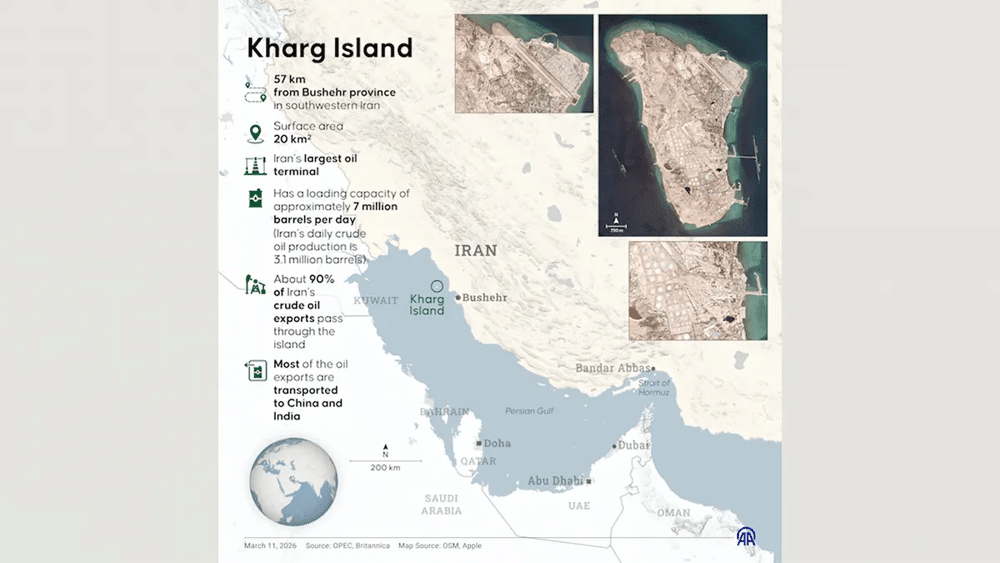
Figure: Infographic of Kharg Island and Iranian oil export infrastructure. Kharg (green) is a small island with enormous capacity: ~7 million barrels/day loading capacity, ~90% of Iran’s crude exports (mostly to China & India) pass through Kharg. Controlling Kharg would require holding large storage tanks and pipelines shown here. (Map data from Reuters/Fox News.) (Image Source)
Planning vs. Coincidence: Institutional Evidence
Is there evidence of a long-term plan? We found none in official records. No declassified National Security Council papers or Pentagon memos explicitly call for seizing Iranian oil. In contrast, abundant documents (sanctions lists, strategy memos) discuss economic pressure, military defence, or air campaigns – not oil capture.
For example:
- Senate and Congressional research on Iran detail sanctions and arms control, but do not mention oil seizure.
- Think-tank analyses (e.g. CFR, Brookings) outline U.S. objectives as nonproliferation or counterterrorism. The Brookings timeline of the nuclear deal is about legal sanctions relief, not military targets.
- Historical war plans (e.g. leaked OPlan 1002 for Iran) focus on regime overthrow, not resource theft.
By contrast, media reports show Trump (and perhaps military aides) alone entertained the idea as a tactic. Axios reports “sources with knowledge” say the White House has considered occupying Kharg to force Iran to reopen the Strait of Hormuz. But Axios also notes senior officials caution this is potential thinking, not an approved strategy. A Pentagon official told Axios no decision had been made and noted media fixation on this plan. Even conservative Sen. Tom Cotton (Ark.) merely said there were “mountains of plans” for contingencies but no public plan.
In summary: the only “plan” we see is Trump’s own. His 1987 and 2026 comments are the same man speaking decades apart. If this were a decades-old plan, one would expect multiple officials across time to reference it; we see only Trump (and in 2026, anonymous aides). No DoD press releases or State Department reports endorse such an approach. All evidence suggests this is coincidence/personal doctrine, not hidden U.S. policy.
International Law and Legality
Seizing civilian oil assets in war faces serious legal barriers. International humanitarian law (the laws of war) generally forbids destroying or seizing an adversary’s civilian property unless “imperatively demanded by the necessities of war.” This standard comes from the 1907 Hague Regulations (Article 23(g)): “It is especially forbidden… to destroy or seize the enemy’s property, unless such destruction or seizure be imperatively demanded by the necessities of war.” Modern analysis confirms that “imperative necessity” does not lower the bar: one may only attack civilian infrastructure (like oil facilities) if it is a direct military objective and no feasible alternative exists. Attacking or occupying an oil terminal primarily for economic gain would likely violate that rule.
The U.S. has felt legal heat before. In the same 1980s conflict, the U.S. Navy bombed Iranian offshore oil platforms as a “retaliation.” The International Court of Justice later ruled those attacks were not justifiable self-defence. Scholars note that unless an oil facility directly supports enemy military operations, hitting it is not “necessary” and could be a war crime (destruction/seizure of civilian property not proven to have military necessity).
Even beyond war law, outright occupying foreign territory for resources runs afoul of the UN Charter’s prohibition on conquest. The concept of “spoils of war” has been legally abolished. For example, ICRC commentary states: “destroying or seizing the enemy’s property, unless imperatively demanded by the necessities of war, constitutes a war crime.” Likewise, occupying an oil terminal solely to profit from it would resemble illegal “pillage.”
In short, legally the U.S. cannot simply “take the oil and keep it.” It would have to justify each strike or seizure as a direct military necessity (e.g. eliminating IRGC anti-ship missiles, etc.), not as resource grabbing.
Historical Precedents of Resource Seizure
The idea of invading for oil has historical echoes abroad, but rarely involved the U.S.:
- World War II: Hitler targeted oil fields (e.g. Baku, Caucasus). Allied strategy was to deny Axis oil, not to commandeer it post-victory. The U.S. itself seized Japanese oil stocks after 1945, but that was war reparation, not a battle plan.
- Iraq 1991: Saddam’s invasion of Kuwait was indeed about oil control. The U.S.-led coalition removed Iraq from Kuwait but did not occupy Kuwaiti oil fields; Kuwait’s sovereignty and oil stayed with Kuwait. (By contrast, Saddam briefly took Kirkuk oilfields in 2003, but U.S. forces, after deposing Saddam, oversaw Iraq’s oil with a focus on production, not annexation.)
- Gunboat diplomacy: The U.S. has boarders on sanction-violating tankers. Recently, the U.S. Coast Guard seized Iranian/Venezuelan tankers (the “shadow fleet”) on the high seas to enforce sanctions. That is an aggressive use of force to seize oil cargo, but it’s framed as law enforcement, not territorial conquest. It required international legal justification and created debates about jurisdiction.
These actions show how to interdict oil shipments, but even they are controversial and limited in scope (and still not outright U.S. seizure of foreign oil resources on land). In Asia or the Pacific, no U.S. strategy has centered on occupying enemy oilfields. The Cold War conquest of resources never manifested in U.S. doctrine. Even in recent conflicts (Iraq 2003), U.S. forces protected infrastructure but left oil for Iraq to use.
By contrast, Trump’s suggestion would be a novel departure. Given these precedents, the 1987 and 2026 statements appear more like impulsive rhetoric than part of an established playbook. They lack historical or policy grounding.
Feasibility and Consequences
- Military and logistical challenges: Analysts agree seizing Kharg would be difficult. Kharg Island is small (20 km²) but heavily defended by anti-ship missiles, drones, and coastal artillery. Fox News (defense analysis) notes the U.S. “can do it” with overwhelming force, but it would take thousands of troops and many ships. Hudson Institute experts warn that holding the island under Iranian counterattack would be tenuous. A heavy US air and naval bombardment might destroy Iranian defenses, but any ground assault risks casualties and turning Kharg into a fortress of asymmetrical warfare.
- Economic and logistical issues: Even if captured, pumping out millions of barrels and transporting them would be non-trivial. Kharg’s pipelines and storage were battered in strikes, and Iran could sabotage fields and switch off pumps. Reuters notes that Trump himself recognized seizing Kharg doesn’t guarantee oil flows: “If we seize Kharg Island, they’re going to turn off the spigot on the other end”. Transporting oil out of Kharg would also require neutralizing Iranian attempts to retake it or block terminals, requiring sustained occupation (which Trump acknowledged: “we had to be there… for a while”). And the U.S. would then need to secure the oil — would it ship it home, sell it, or give it to an ally? Each choice has diplomatic ramifications.
- Diplomatic fallout: Allies and neutrals could balk at a naked resource grab. Invading an OPEC nation to take oil would isolate the U.S. internationally. Even supporters of pressure on Iran see such a step as extreme. Trump himself noted the need to weaken Iran militarily before taking Kharg – implying it’s not a casual move. Senior officials reportedly stressed to Axios that boots on the ground “happens under every president” but that the media “fixation” on Kharg wasn’t yet policy. Tom Cotton and other hawks stopped short of endorsing outright seizure, focusing on closing the Strait by other means.
- Alternatives exist: Economists and strategists argue the U.S. can punish Iran’s oil economy without invasion. For example, contracting with Iranian producers via international bodies or forming an international escort convoy (as suggested by Rear Admiral Montgomery) could reopen the Strait. Satellite tracking of shipments, sanctions on Chinese tankers, and naval freedom-of-navigation patrols can bypass Kharg without seizure. These options involve less risk and remain in line with current law.
In short, while a US military could physically take Kharg with massive effort, doing so would be bold, costly and likely counterproductive. The feasibility is low unless the war is already at a breaking point, and even then the benefits are questionable.
Alternative Explanations and Rhetorical Context
Rather than a plan, the 1987 and 2026 comments fit Trump’s personal style: shock-and-awe rhetoric that signals toughness. In 1987 he was on TV pitching himself; in 2026 he was in full wartime debate mode. Both times, his remarks were reported as off-the-cuff advice, not an internal strategy memo. Indeed, other administration figures (even Trump allies) have sometimes gently corrected or downplayed the oil talk. For example, Axios quotes a senior official saying “that decision [to invade Kharg] hasn’t been made”. The Pentagon lawyer consultation on Kharg’s legality suggests caution.
Media framing may amplify coincidences. The resurfaced 1987 clip went viral not because it was state policy but because it was a surprising echo. Some commentators argue it’s a prediction only in hindsight: Trump said something similar years ago and now it’s in headlines. Others caution about “conspiracy tone”, pointing out that thousands of interviews exist and some overlap was bound to happen. No credible journalist or historian has uncovered classified documents to call it a 39-year-old plan.
It is true, however, that hawkish voices in the U.S. have for decades discussed attacking Iran’s economy in various forms. For instance, neo-conservatives in the 2000s floated interdiction of Iran’s oil revenues (but again, via sanctions, not invasion). Congressional bills have been considered to buy Iranian oil on global markets to keep revenue out of Tehran’s hands. None of these proposals advocated actual seizure of territory. Thus, an individual call to “take their oil” stands out as idiosyncratic, not representative of a stable doctrine.
Counterevidence
- Lack of repeated official mention: No President or general after 1987 (Bush, Obama, Biden) ever said “take their oil.” Key Iran strategies (sanctions, nuclear deal, military posturing) never included such language.
- Mixed messaging from Trump: In March 2026 Trump also tweeted about unfreezing some Iranian oil at sea (Newsweek reported he considered releasing 140 million barrels to help the market). That is the opposite of “seize and keep,” suggesting confusion or multiple tactics.
- Global reaction: Allies (NATO, EU) publicly advocate de-escalation, not new conquests. There has been no diplomatic coalition formed to implement any oil takeover.
Taken together, the counterevidence supports the idea that this is not entrenched policy. The continuity is better explained by it being the same person saying the same idea 39 years apart – rather than an official strategy surviving administrations unnoticed.
Timeline of Key Moments (1987–2026)
Below is a chronological overview of events and statements, illustrating how the oil-seizure idea appears as isolated incidents rather than a continuous thread:
|
Event |
Source / Notes |
|
|---|---|---|
|
Dec 1987 |
Trump on 20/20: “take over some of their oil… grab it and keep it.” |
Walters interview transcript |
|
Apr 1988 |
Operation Praying Mantis – US Navy destroys Iranian oil platforms (in response to missile attacks) |
Deterrent, no occupation |
|
Aug 1995 |
EO banning U.S. business with Iran (including oil sector) |
Clinton sanctions, ILSA (1996) |
|
Jul 2015 |
JCPOA nuclear deal signed (in exchange for lifting many oil sanctions) |
International agreement |
|
May 2018 |
Trump withdraws from JCPOA; US reimposes sanctions on Iranian oil |
US policy shift |
|
Jan 2020 |
Killing of IRGC Qods Force commander Soleimani – US–Iran tensions spike |
Precursor to 2026 war |
|
Feb 2026 |
Iran launches war on US/Israel; Strait of Hormuz closes |
Context: war scenario |
|
Mar 2026 |
US forces concentrate in Gulf; heavy strikes on Kharg Island |
US war operations |
|
Mar 30, 2026 |
Trump tells FT: “take the oil in Iran… maybe we take Kharg Island” |
Re-emergence of 1987 idea |
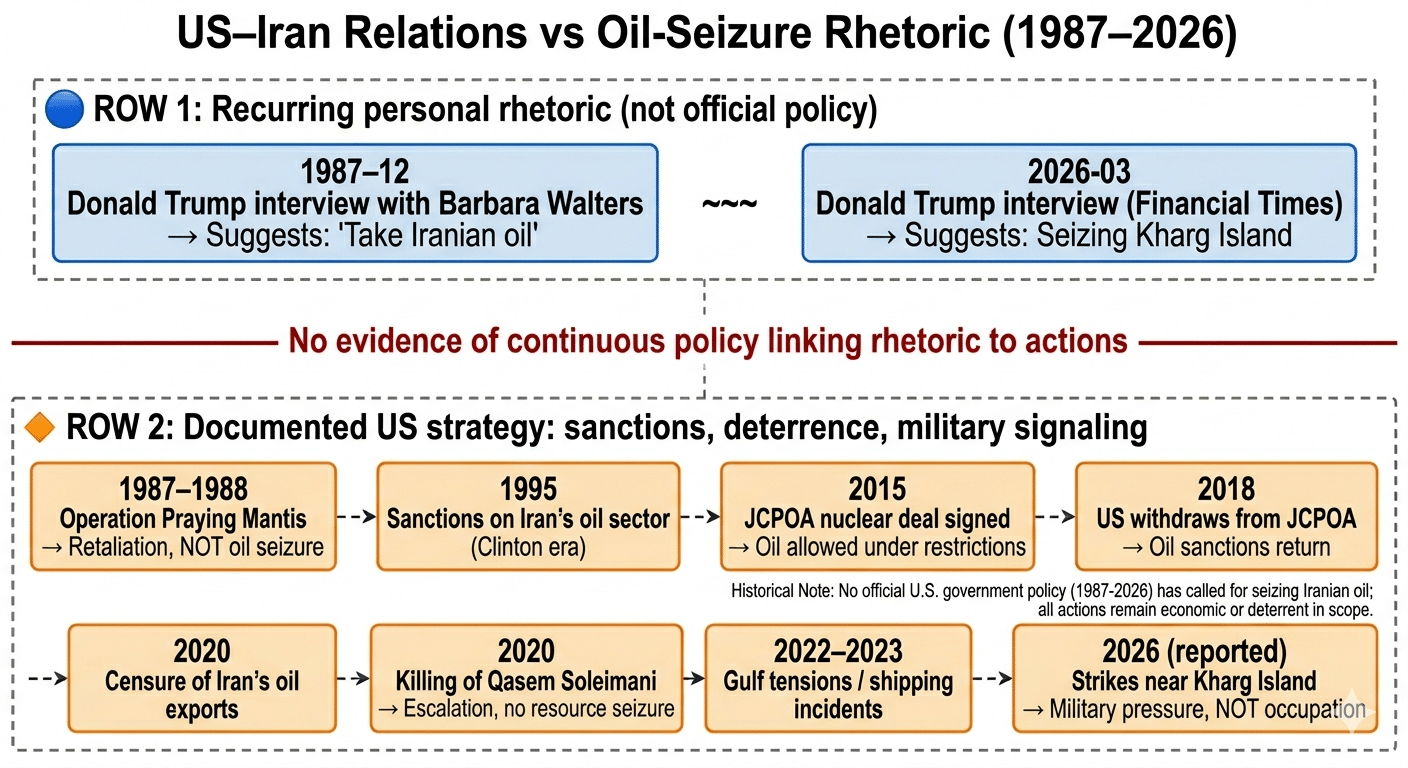
Figure: Timeline of US–Iran events. The highlighted quotes from Trump occur in Dec 1987 and Mar 2026, three decades apart, with numerous unrelated Iran policies in between.
Conclusion and Further Research
The 1987 Barbara Walters clip and the 2026 FT interview present an uncanny echo, but the evidence strongly indicates this is a coincidence of personal rhetoric, not a decades-old strategy. The persistence of the idea seems to be Trump’s own hawkish view, resurfacing whenever war with Iran heats up. We found no official documents or policies spanning 1987–2026 that endorse seizing Iranian oil fields. All known U.S. actions have been sanctions and (in wartime) targeted strikes, not territorial grabs. We conclude that this was a prediction only in the sense of Trump predicting his own rhetoric; it is not proof of a hidden long-term plan. Any true plan would leave trails in interagency memos or military orders, which are absent.
That said, the question raises important issues about oversight: even if an idea comes from the President’s mouth alone, wartime uses of force deserve scrutiny. We recommend further investigation into internal planning documents, such as:
- Operation Plans and Objective Lists: FOIA requests could target the Joint Staff or Combatant Command records for any mention of “Kharg” or “oil fields” in planning.
- NSC Records: Minutes or drafts from National Security Council meetings (if they exist in memoranda) around late March 2026 may clarify who floated the idea.
- Pentagon Legal Memos: Axios reported Pentagon lawyers were asked about Kharg’s legality. Requesting these memoranda could reveal whether the discussions were routine counsel or serious deliberation.
In absence of new evidence, analysts and the public should treat the 1987 quote as a colorful historical footnote, not a prescription. It does, however, highlight the value of transparency: outlandish ideas sometimes percolate into policy debates, and without accountability they can linger in the system. The U.S. government should clarify whether and how it decides what suggestions from private citizens-turned-presidents actually become policy.
The 39-Year “Oil-Grab” Theory
Video: Did Trump Plan to Seize Iran’s Oil 39 Years Ago?
The video report by CCASTER ™ highlights a remarkable consistency in Donald Trump’s rhetoric regarding Iran. By comparing his 1987 ABC “20/20” interview with his March 2026 Financial Times remarks, the analysis shows that the core suggestion—physically seizing Iranian oil installations—has remained virtually unchanged for nearly four decades.
- 1987 Suggestion: Trump argued that the U.S. should “go in and take over some of their oil” as a display of strength.
- 2026 Proposal: Trump explicitly identified Kharg Island as a target, stating his “favourite thing is to take the oil in Iran”.
- The Question of Intent: While the video asks if we are witnessing a “plan decades in the making,” actual U.S. policy records from 1987 to 2026 show no such institutional doctrine.
Instead of a secret government strategy, the evidence suggests these “uncanny echoes” are a reflection of Trump’s personal views resurfacing during periods of heightened conflict. While the rhetoric suggests a “resource grab,” documented U.S. actions have consistently focused on economic sanctions, military deterrence, and targeted strikes rather than territorial occupation for oil.
Sources: We relied on primary transcripts and reputable reporting: the original interview excerpts, analyses by Hudson Institute and Fox News, legal reviews, and historical timelines from CFR, Brookings, and news archives. All quotes and data are cited above.