There is a running joke in the tech community that Apple can’t even make its own cameras, and in a literal manufacturing sense, that is completely true. Apple does not run a consumer CMOS image-sensor fabrication business. However, framing it this way is highly misleading because, in modern smartphones, the “camera” is an entire system consisting of the sensor, lens, stabilization, ISP, and software. Apple controls a surprising amount of that system, even when it buys the iPhone camera sensor from external suppliers like Sony—and potentially, in the near future, Samsung.
The Reign of Sony’s iPhone Camera Sensor
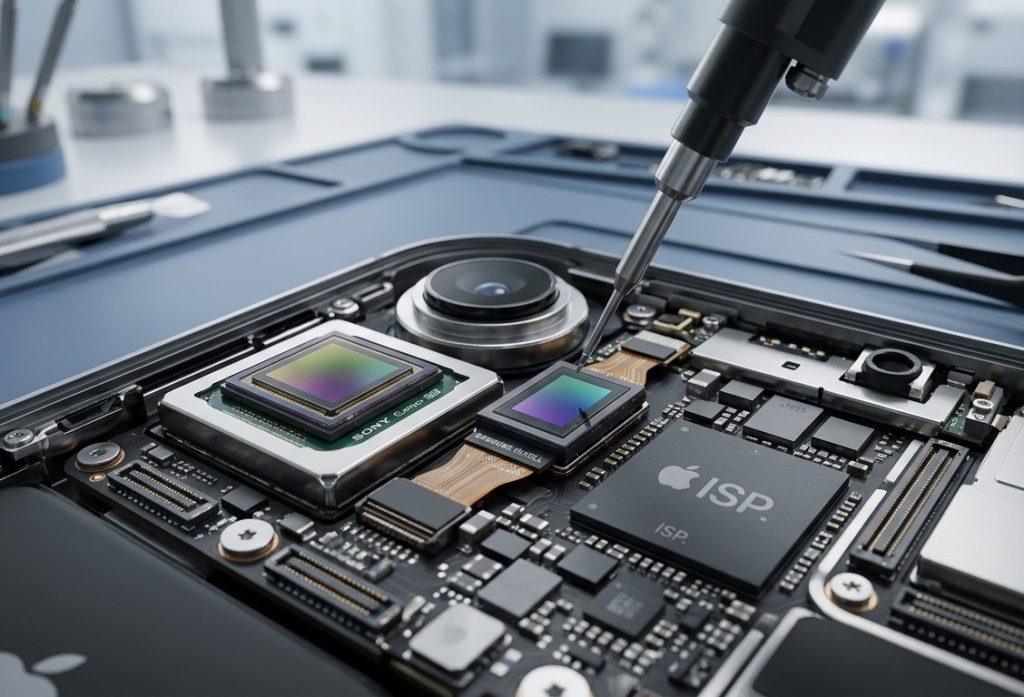
If you look inside almost any modern iPhone, you will find Sony hardware. As of April 10, 2026, the confirmed reality is that Sony has been Apple’s long-running image-sensor partner “for over a decade,” according to Tim Cook. Teardown and benchmark intelligence continues to identify Sony sensors inside recent iPhones. For example, technical analysis documented a Sony 48MP Exmor RS sensor extracted from the iPhone 14 Pro Max rear wide-angle camera.
Why Sony?
Sony has been the dominant premium smartphone image-sensor supplier for years, and Apple tends to stick with a partner when that partner can co-develop custom parts at massive scale. Sony has continuously pushed the boundaries of stacked and Backside Illumination (BSI) architectures, including “2-layer transistor pixel” designs meant to expand dynamic range and cut noise. You can dive deeper into their stacked pixel architecture on Sony’s official semiconductor page.
The Rumored Samsung Shift
What has changed in the 2023–2026 window is the credibility of a Samsung entry into the supply chain. Apple has publicly confirmed a new chipmaking collaboration with Samsung at Samsung’s Austin, Texas fabrication plant. Reuters also reported Apple saying that Samsung would supply chips from that Texas plant for Apple products, including iPhones.
While Apple and Reuters did not publicly specify “camera sensors” in the announcement, multiple reputable reports describe the project as advanced stacked image sensors aimed at future iPhone models. A well-followed Apple analyst, Ming-Chi Kuo, even noted that Apple could adopt a Samsung-made 48MP Ultra Wide sensor as early as 2026, which would break Sony’s monopoly.
Technically, Sony and Samsung both make excellent sensors, but their flagship approaches differ:
- Sony heavily pushes stacked architectures designed to expand dynamic range and cut noise.
- Samsung often pushes ultra-high resolution with aggressive pixel isolation and pixel-binning strategies, plus stacked sensors with on-sensor DRAM for speed.
Why Would Apple Diversify Its iPhone Camera Sensor Supply?
Even ignoring the “frenemies” dynamic between Apple and Samsung, multi-sourcing is a rational move when a single iPhone generation requires massive sensor volumes.
- Scaling iPhone camera sensor production is slow, expensive, and geographically concentrated.
- Adding another supplier or manufacturing geography can reduce single-point-of-failure risks.
- Apple can get better pricing and terms when there’s credible competition for supply.
- Strategically, Apple’s August 2025 U.S. manufacturing announcement aims to build out a U.S.-based silicon manufacturing ecosystem.
- The announcement explicitly calls out the Samsung Austin fab as a source of chips for globally shipped iPhone devices.
(For more insights into how hardware ecosystems impact workplace environments, check out our latest CCASTER tech culture updates.)
The Real “Camera Factory”: Apple’s Software
Ultimately, the name stamped on the iPhone camera sensor isn’t what makes an iPhone photo look like an iPhone photo. Regardless of the supplier, Apple’s ISP and computational photography pipeline is a major determinant of what your photos look like.
Apple designs the capture pipeline from the ground up. The company introduced the “Photonic Engine” as part of the iPhone camera sensor, describing it as a computational photography advance that improves mid- to low-light performance across cameras via deep hardware and software integration. Apple’s tech specs continue to list features like the Photonic Engine, Deep Fusion, and Smart HDR right alongside physical lens specs and zoom ranges.
So, if Samsung parts do arrive in upcoming iPhones, it won’t mean your photos will suddenly look like they were taken on a Galaxy device. It simply means Apple is securing the capacity, leverage, and manufacturing localization it needs, while keeping the photographic magic firmly in its own hands.