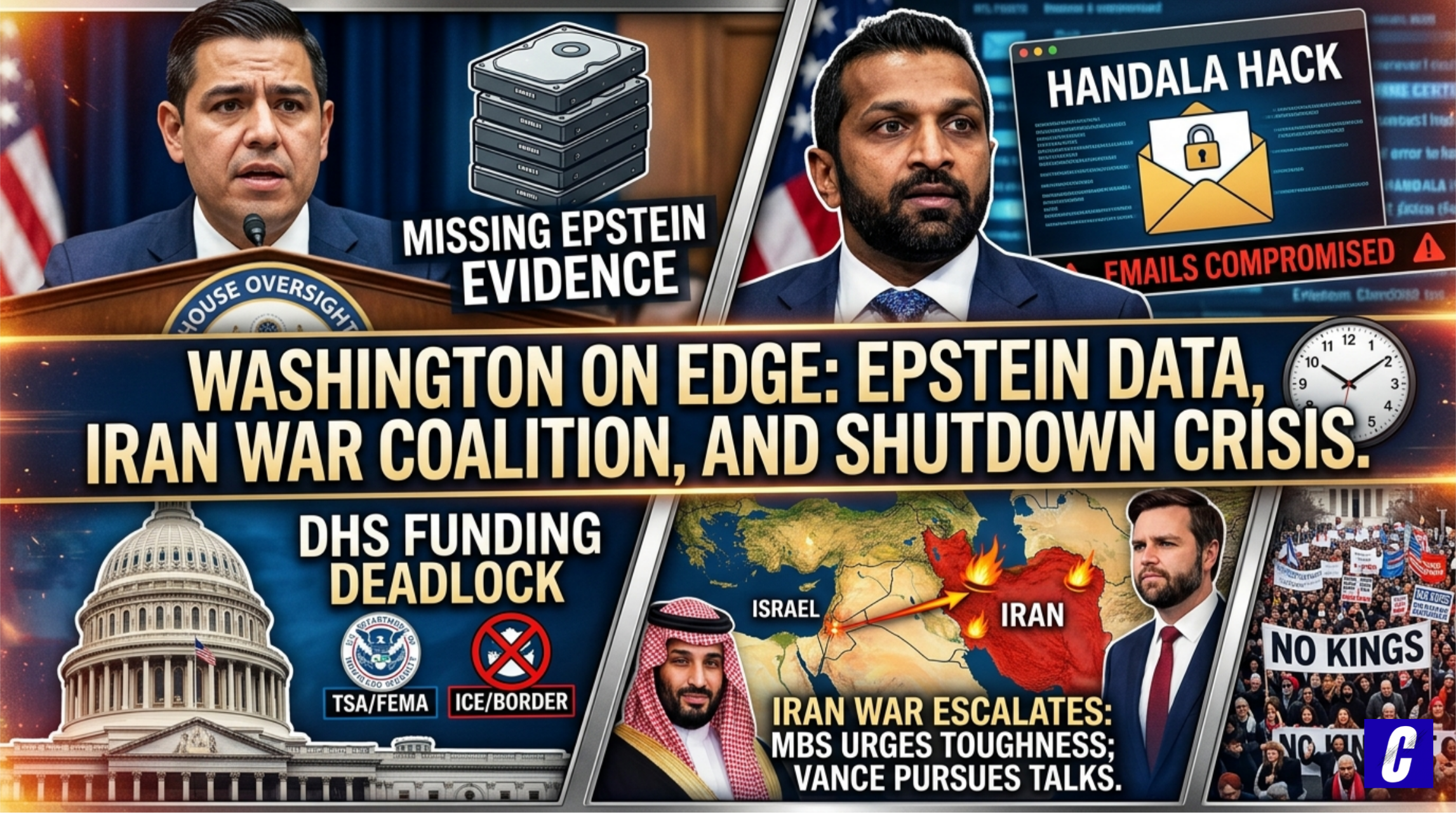
Deck: New revelations about Jeffrey Epstein’s case colliding with an intensifying U.S.–Iran conflict have Washington on edge. House Democrats are demanding answers about missing Epstein evidence even as Iranian hackers claim to expose the FBI director’s emails. Meanwhile, Congress is scrambling to reopen government – passing a partial DHS funding bill – amid nationwide “No Kings” protests and global pressure to extend the Iran war.
The Epstein Investigation Reopens
House oversight investigators have uncovered that private detectives removed computers and records from Jeffrey Epstein’s homes before police ever searched them – evidence law enforcement likely never saw. Rep. Robert Garcia (D-Calif.) warned it’s “stunning that Epstein’s computers and hard drives were…in the possession of Epstein’s private investigators” with potentially crucial data missing【85†】. At the same time, Iranian hackers (the “Handala Hack” group) claim to have breached former FBI Director Kash Patel’s personal email, posting photos and a resume online. A U.S. official confirmed Patel’s inbox was compromised, though the authenticity of all files is still being vetted.
On Capitol Hill, lawmakers pushed ahead with deadlocked budget battles. The Senate on March 27 approved a stop-gap DHS spending bill to reopen most homeland agencies – funding the TSA, FEMA, Coast Guard and more – but explicitly left ICE and border enforcement unfunded. Republicans are furious, demanding immigration reforms in exchange. The bill now heads to the House, where Speaker Johnson says votes could come as soon as the current recess ends. In related news, a class-action suit by dozens of Epstein survivors accuses the DOJ and Google of exposure of their private data, while major banks (UBS) and modeling executive Faith Kates face scrutiny for years-long ties to Epstein.
Abroad, the Middle East war has entered its fourth week. Saudi Crown Prince Mohammed bin Salman reportedly urged the U.S. not to cut the war short – calling it a “historic opportunity” to defeat Iran. Israeli leaders are echoing this toughness: Defense Minister Yoav Gallant announced Israel will “step up” strikes on Iran to halt missile attacks, warning Tehran will pay a “highly price”. Reuters reports U.S.–Israeli airstrikes have already killed key Iranian figures, including Supreme Leader Ali Khamenei and top generals. With fuel prices and global shipping disrupted, even loyal U.S. allies press for a negotiated halt: media say Vice President J.D. Vance may soon travel to Pakistan for Iran-deescalation talks. Domestically, activists are mobilizing: organizers expect over 3,000 “No Kings” marches across the country on March 28, potentially the largest single day of protest in U.S. history, reflecting anger over immigration raids, the ongoing war, and more.
Timeline of Key Events (2005–2026)
2005–07Police raid Epstein’s Palm Beach home. FBI finds computers and records missing – later discovered in private investigators’ possession.
2008–09Jeffrey Epstein pleads guilty in Florida to state charges, avoiding a wider federal trial.
2019–12Ghislaine Maxwell arrested at her New Hampshire estate, financed by a UBS-backed transaction.
2025–11President Donald Trump signs the Epstein Files Transparency Act, ordering DOJ to release all Epstein case records.
2026–02US-Israeli airstrike kills Iran’s Supreme Leader Ali Khamenei and other top officials.
2026–03–16Gulf Arab leaders urge Washington not to end the Iran war prematurely.
2026–03–26Reports emerge that Vice President J.D. Vance may visit Pakistan as a U.S. envoy to negotiate an end to the Iran war.
2026–03–26Iran-linked “Handala Hack” claims breach of former FBI Director Kash Patel’s personal email, leaking documents.
2026–03–27Senate passes a DHS funding bill without funding ICE or border agents.
2026–03–27Saudi Crown Prince Mohammed bin Salman calls the Iran campaign a “historic opportunity.”
2026–03–27Israel’s defense minister says strikes on Iran will intensify.
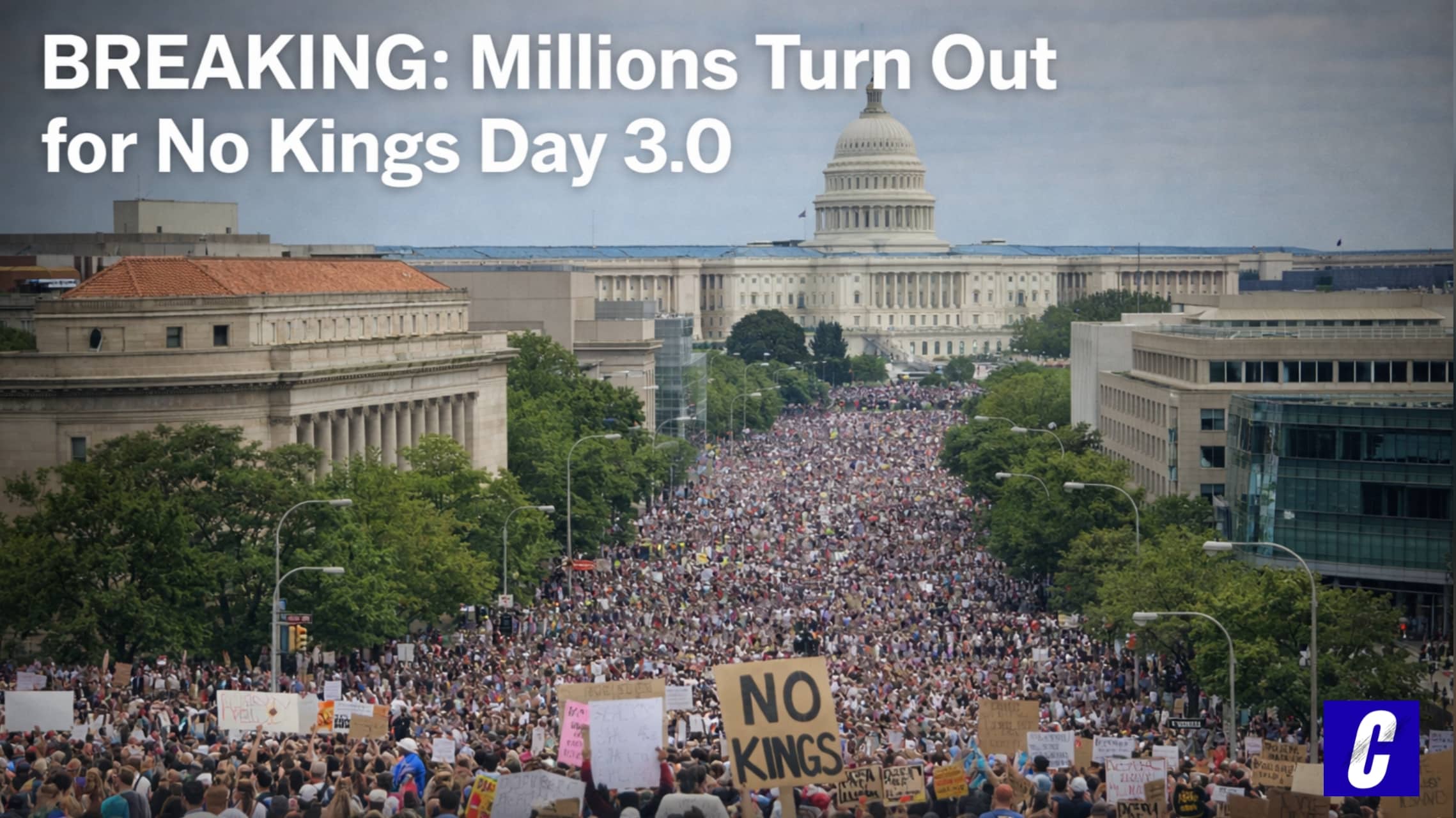
2026–03–28Nationwide “No Kings” protests with over 3,000 rallies across the U.S.
Epstein Case Back in Spotlight
Investigation files long thought dormant are suddenly front-page news. House Oversight Democrats have subpoenaed or summoned private investigators linked to Jeffrey Epstein, after learning that entire hard drives and phone records were removed from Epstein’s homes before the FBI arrived. One investigator’s memo (from 2005) even listed a trove of evidence the team took out – from computers to photo albums – saying the haul “may be material to any proceedings.” Until now, prosecutors never knew exactly what those investigators had found.
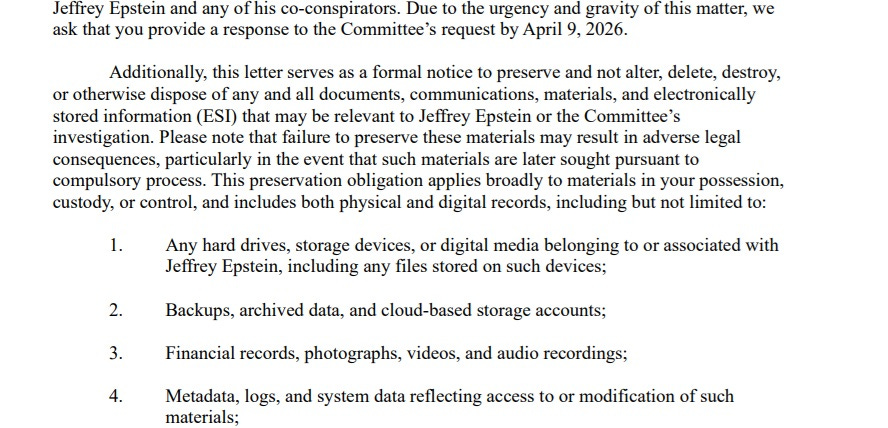
Image: Excerpt of a March 2026 House Oversight preservation letter to Epstein investigators, demanding they hold all evidence (hard drives, documents, digital media) related to Epstein【84†】. The discovery of missing files led Democrats to open a new probe. Credit: Congressional Oversight Committee (via Aaron Parnas/Substack).
“This is stunning,” Rep. Robert Garcia (D-Calif.), the committee’s ranking member, said in a statement【85†】. He noted that Epstein’s private team held “computers and hard drives” never seen by law enforcement. “Oversight Democrats working to access these hard drives and records,” Garcia vowed, “will identify every co-conspirator who shielded Epstein and hold them accountable.”【85†】 His comments echo a recently declassified 2009 DOJ report faulting former U.S. Attorney Alex Acosta’s light plea deal, and buttress survivors’ long-held suspicions that key evidence was kept off the record.
Epstein’s victims are watching closely. On March 27, a coalition of survivors filed a class-action lawsuit in California accusing the DOJ of reckless data mishandling. They say that during the court-ordered release of Epstein case documents this winter, officials failed to properly redact names, exposing dozens of victims online[7]. Even after the DOJ attempted to scrub identities, search engines and other websites (like Google) continued to make the information accessible. “Strangers call them, email them, threaten their safety, accuse them of conspiring with Epstein when they are victims,” the suit alleges. Plaintiffs demand at least $1,000 per survivor for the harm, and reforms to prevent future doxxing. A Justice Department spokeswoman said the agency is still evaluating compliance with the new transparency law.
Meanwhile, additional Epstein-linked disclosures are emerging. Reuters reported that UBS – the global bank – transferred millions of dollars on Ghislaine Maxwell’s behalf just weeks before she bought her New Hampshire hideaway in late 2019. Shockingly, these wire transfers were processed even after federal investigators had subpoenaed UBS in August 2019, demanding all records on Maxwell. UBS had told Maxwell on August 1, 2019 that it would cut ties with her “within a month,” yet in November 2019 it still funneled money through trusts to pay for her $1.1 million house. This sequence raises questions about how a major bank was apparently circumventing subpoenas to keep Maxwell afloat.
Adding to the intrigue, The Guardian uncovered a decades-long friendship between Epstein and Faith Kates, founder of the modeling agency Next Management. Internal emails show Kates offering Epstein “unconditional support” even after his 2009 sex-crime conviction, seeking his business advice, and — troublingly — introducing some of her young models to him. Next Management says it has now “moved to sever any ties” with Kates, claiming her Epstein connections were unknown internally.
“It’s stunning that Epstein’s computers and hard drives were… in the possession of Epstein’s private investigators and may never have been seen by any law enforcement agency,” Rep. Garcia said in a statement【85†】. “Oversight Democrats…working to access these hard drives and records…will identify every co-conspirator who shielded Epstein and hold them accountable.”
Cybersecurity and Political Upheaval
Amid these domestic flashpoints, foreign drama is unfolding. This month a shadowy Iran-linked hacking group known as Handala Hack put former FBI Director Kash Patel in the crosshairs. On social media and dark web forums, the hackers claimed they had breached Patel’s personal email account and dumped reams of data online – including photos, CVs and correspondences from 2010–2019. For example, the main image released by the hackers is a collage of Patel’s known photographs stamped “Handala Hack”【83†】. A U.S. Justice Department official later confirmed to Reuters that Patel’s inbox had indeed been compromised. Analysts caution that some posted files might be fabricated or out-of-context, but at least one sample (reviewed by Reuters) appeared genuine, mixing personal notes and job applications.
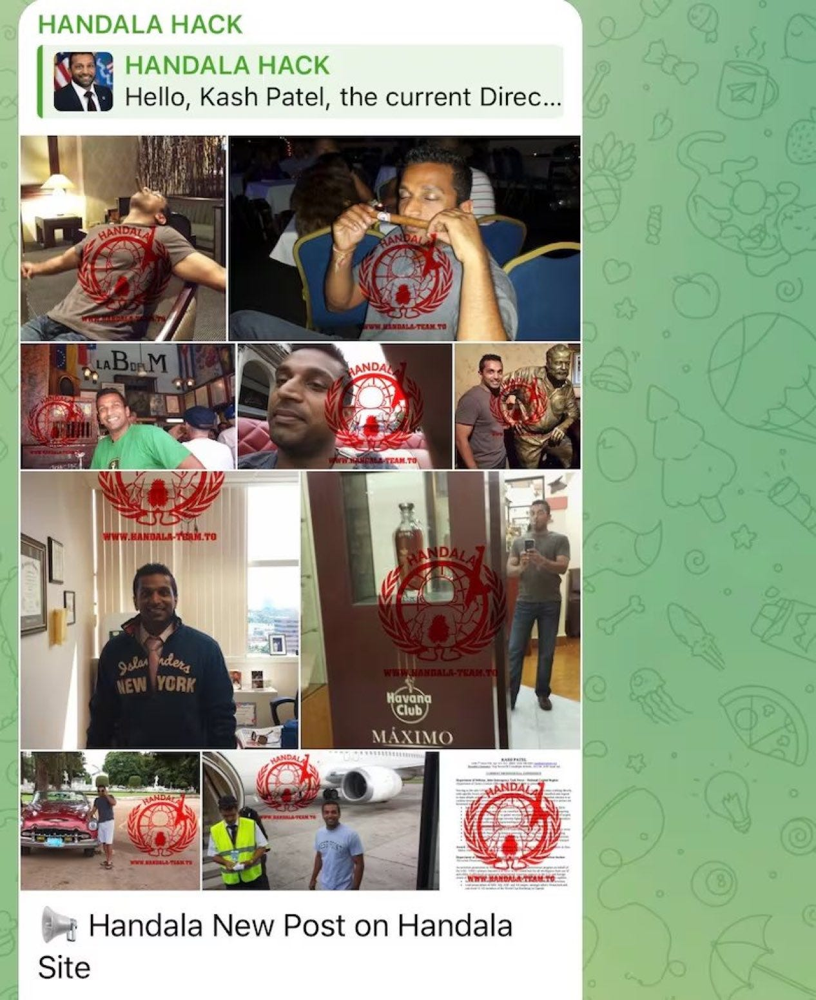
Image: Collage published by Iranian hackers claiming to have breached Kash Patel’s email. The image (centered on Patel’s face) is watermarked “HANDALA-TEAM.TO”. The group also released private photos and documents allegedly from Patel’s personal account. Credit: Aaron Parnas/Substack.
Patel, who became FBI Director in the Trump administration, responded with a terse statement: “We will investigate the identity of every person and group associated with any breach of U.S. data.” Security experts warn this hack is part of a broader wave of Iranian cyber operations against U.S. officials since the Middle East war began. (Days earlier, in mid-March, the FBI and prosecutors unsealed charges against dozens of Iranian hackers tied to military intelligence – some of whom are known to use the Handala Hack network to leak stolen data.)
In Washington, the hack is one more sign that national security fronts are simultaneously heating up. Vice President J.D. Vance – once considered sidelined – is now emerging as a chief U.S. negotiator on Iran. Media reports say Vance may soon travel to Pakistan for peace talks, after Iranian envoys balked at meeting Trump’s other intermediaries. The White House brushed off this shift, noting Vance has always been the president’s “right-hand man” and a fixture on national security calls. Even so, Iran’s allies see Vance as less hawkish than previous envoys, underscoring the delicate diplomacy underway.
“The vice president has always been a key member – the president’s right-hand man… He’s been part of these discussions the entire course of the administration,” White House Press Secretary Karoline Leavitt told reporters, defending Vance’s elevated role.
Funding and Fragmentation in Congress
The government shutdown at the Department of Homeland Security also neared resolution. On March 27 the Senate narrowly approved a bipartisan emergency spending bill to re-open most DHS agencies. Vital operations at the TSA, Coast Guard, FEMA, Secret Service and other offices would resume. Notably, the package excludes funding for Immigration & Customs Enforcement and large parts of Customs and Border Protection. Democrats insisted on this carve-out to demand reforms, arguing border agencies must be restructured (for example, by converting ICE into an “immigration enforcement” branch) before any new money flows.
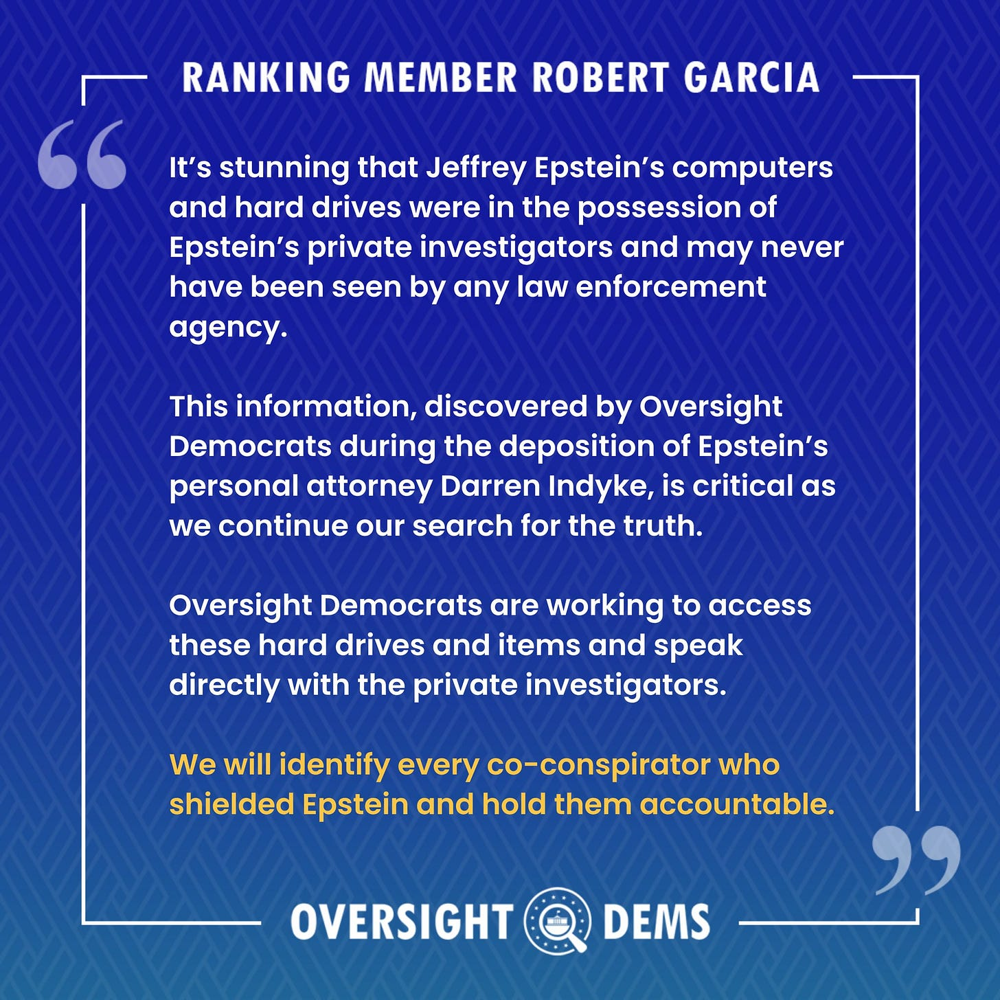
Image: Rep. Robert Garcia (D-CA) speaking about the Epstein evidence revelations. Oversight Democrats posted graphics (like this one) on social media highlighting their findings that Epstein’s hard drives were held by private investigators, not law enforcement【85†】. Credit: Rep. Robert Garcia/Twitter (via Aaron Parnas/Substack).
Senate GOP leaders blasted the deal. Sen. Eric Schmitt (R-Mo.) warned Democrats they were “playing politics” and vowed to force funding for ICE/CBP via long-term budgets later. House Speaker Mike Johnson (R-La.) called the outcome “unfortunate” and said he remained “committed to ending the [shutdown] at the earliest opportunity.” The House, which had already passed its own short-term DHS funding bill in February, was expected to take up the Senate text immediately after the break.
Pull quote: “This is up nearly 40% from the first No Kings Day of Action… In Idaho, Wyoming, Montana, Utah – we’re seeing in Republican leaders’ own backyards powerful pushback,” said Leah Greenberg of Indivisible, as organizers announced an expected 3,000+ “No Kings” protests nationwide.
Rising Tensions and March 28 Protests
Frustration with Trump’s policies is fueling mass demonstrations. Organizers of “No Kings” Day – an anti-authoritarian movement – warned that over 3,100 rallies would occur across all 50 states on March 28. The planned turnout could make it the largest day of domestic protest in U.S. history. Notably, 66% of these events are slated outside major cities and roughly half in Republican or swing states, as grassroots activists dramatize “pushback” even in conservative areas. Participants cite multiple grievances: the administration’s immigration raids, the ongoing Middle East war, crackdowns on civil liberties, and more. In Minneapolis, organizer rallies highlight U.S. border troops deployment and the Strait of Hormuz crisis; elsewhere, chants accuse the president of autocracy, echoing signs that proclaim “Elect a clown, expect a circus” (see photo).
Elsewhere, foreign pressure on the war intensified. Saudi and other Gulf Arab leaders have privately urged the U.S. to keep up its military campaign against Iran, fearing that stopping short would leave Tehran able to threaten oil shipping. As one Saudi analyst put it, Arab capitals worry: “If the Americans pull out before the task is complete, we’ll be left to confront Iran on our own”. Riyadh’s crown prince is said to view the conflict as a rare chance to diminish Iran’s power, though Saudi officials publicly hedge that they do “not seek escalation.” Meanwhile, global reaction is mixed: reports of U.S. and Pakistani mediation continue, and even Russia is accused of discreetly aiding Tehran. Israel, for its part, appeared to ramp up strikes: after killing Khamenei in February, it has targeted Iran’s remaining leadership, inflicting severe personnel losses.
At the same time, the war’s humanitarian fallout mounts. Iranian state media cites nearly 2,000 dead and 20,000 injured in the conflict. Lebanon’s UN refugee agency reports 370,000 displaced children so far. Crucial Iranian infrastructure – museums, mosques, and power plants – has suffered damage, threatening historical heritage and stability. And both sides have tightened the Strait of Hormuz choke-point. Iran now bars shipping linked to the U.S. and Israel, a bid that sent oil prices spiking. Western officials warn that these moves endanger the world economy and risk dragging in major powers.
Pull quote: “IDF strikes in Iran will intensify and expand… They will pay a heavy, an increasingly heavy, price for this war crime,” declared Israeli Defense Minister Yoav Gallant, referring to Tehran’s continued missile launches.
As one Middle East observer noted, the stakes could hardly be higher: a regional war now spanning from Iran to Yemen and into South Asia, with global refineries and markets at risk. Back home, Congress and the courts may soon face yet more fallout – from contested refugee policies to potential challenges over presidential orders. For now, Americans are witnessing an unusually crowded news cycle: old secrets from a notorious pedophile’s empire being re-opened, the nation’s top security official hacked, millions marching, and war clouds gathering. The coming days will test whether Washington can manage these crises coherently – or instead watch events careen out of control.
| Claim | Corroboration Status | Sources |
|---|---|---|
| Epstein investigators removed computers and files from his home that DOJ never received | Corroborated | ABC News[1] |
| Iran-linked hackers claim to have breached Kash Patel’s personal email and posted data | Corroborated | Indian Express[2] (quoting DOJ official) |
| House Oversight Dems seek testimony from Epstein’s investigators | Corroborated | ABC News[1] |
| Epstein survivors filed a class-action suit vs DOJ/Google over exposed identities | Corroborated | Courthouse News/Daily Voice[7] |
| Documents show UBS wired millions for Ghislaine Maxwell’s NH hideaway | Corroborated | Reuters[8] |
| Model agent Faith Kates had a decades-long relationship with Epstein | Corroborated | The Guardian[9] |
| Senate passed DHS funding bill excluding ICE/CBP | Corroborated | ABC News[3] |
| House to consider DHS spending bill next | Corroborated | ABC News[6] |
| Organizers plan ~3,100 “No Kings” protests nationwide | Corroborated | TIME Magazine[4] |
| Saudi Crown Prince urged US to intensify campaign against Iran | Corroborated | The Guardian[5][10] |
| Israel to “intensify” strikes on Iran; heavy casualties reported | Corroborated | The Guardian[11][16] |
| VP J.D. Vance emerging as key figure in Iran war negotiations | Corroborated | NDTV/CNN report[14][15] |
More from CCASTER.com
The Epstein Investigation
- Epstein Files Explained: What’s Redacted and Where to Find Them – Our comprehensive guide to the DOJ’s “Epstein Library” and the ongoing controversy over missing investigative files.
- The 2% Fraction: Why Survivors Believe the FBI is Holding Back Evidence – An analysis of recent claims that only a small portion of retrieved data has been made public.
National Security & Cyber Warfare
- Kash Patel Targeted: Inside the Iranian Cyber Campaign Against U.S. Officials – Background on the “Handala Hack” and the escalating digital conflict between Washington and Tehran.
- Cyber Defenses Weakened: The Real-World Cost of the DHS Shutdown – How the current funding stalemate is leaving critical infrastructure vulnerable to foreign adversaries.
Macroeconomics & Global Conflict
- Oil Market Volatility: Crude Prices Surge as Strait of Hormuz Tension Peaks – A report on how the 2026 Iran War is disrupting energy security and global shipping lanes.
- MBS and the Iran Gamble: Why Saudi Arabia is Pushing for a Decisive End – Analyzing the high-stakes calculations of the Saudi Crown Prince as the regional conflict intensifies.
Domestic Policy & Activism
- No Kings March 2026: Mapping the 3,000+ Protests Across the U.S. – Use our interactive map to find the March 28 rally nearest to you and see the movement’s core demands.
- The Senate Standoff: Why the DHS Funding Bill Excludes ICE and Border Patrol – A breakdown of the legislative battle between Senate Democrats and the White House.