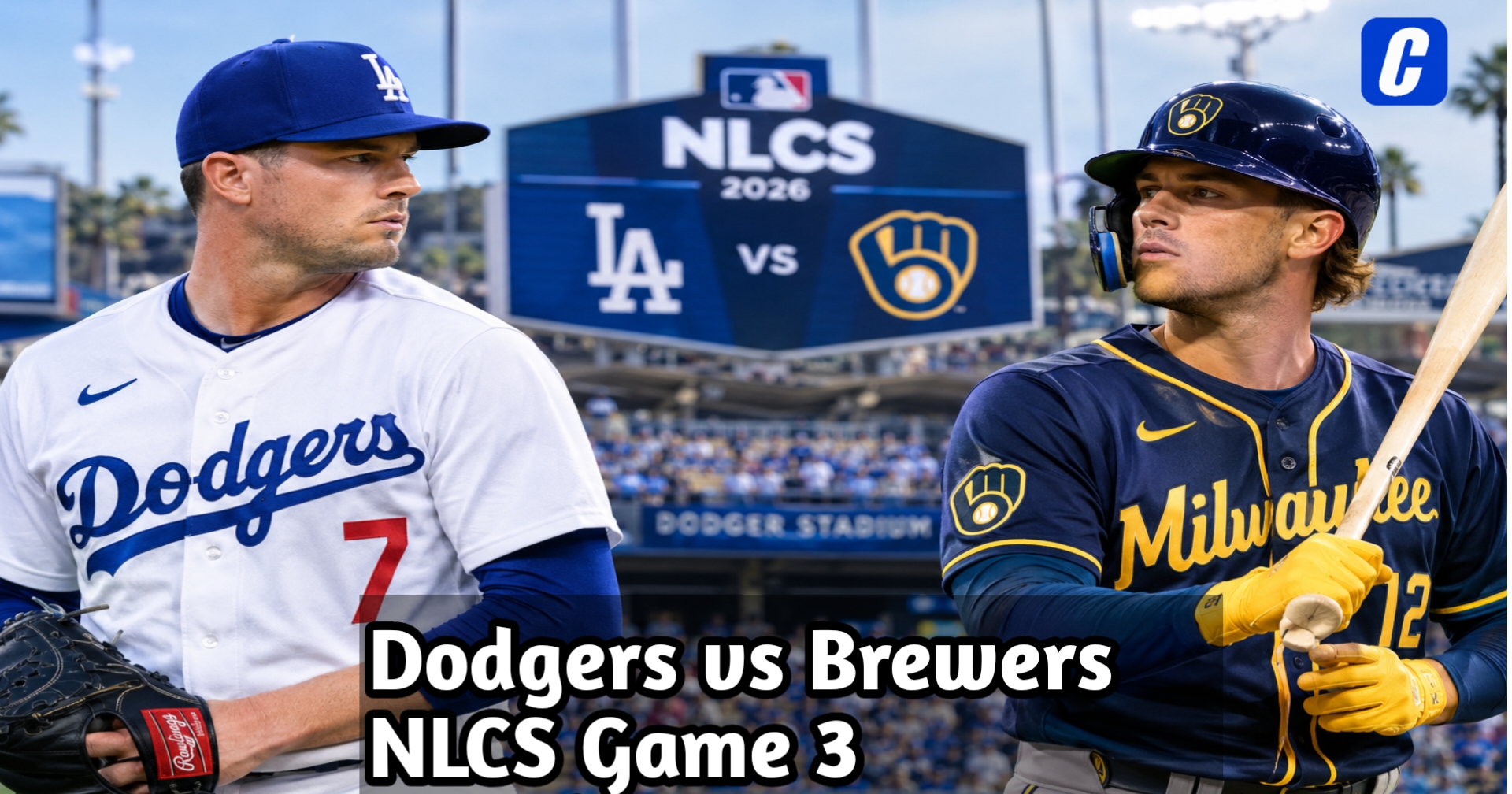
The Los Angeles Dodgers finally looked ready to take control of the game. A two-run double from Will Smith had given them a 2–1 lead, and the crowd at Dodger Stadium had something to celebrate. But the Milwaukee Brewers had other plans.
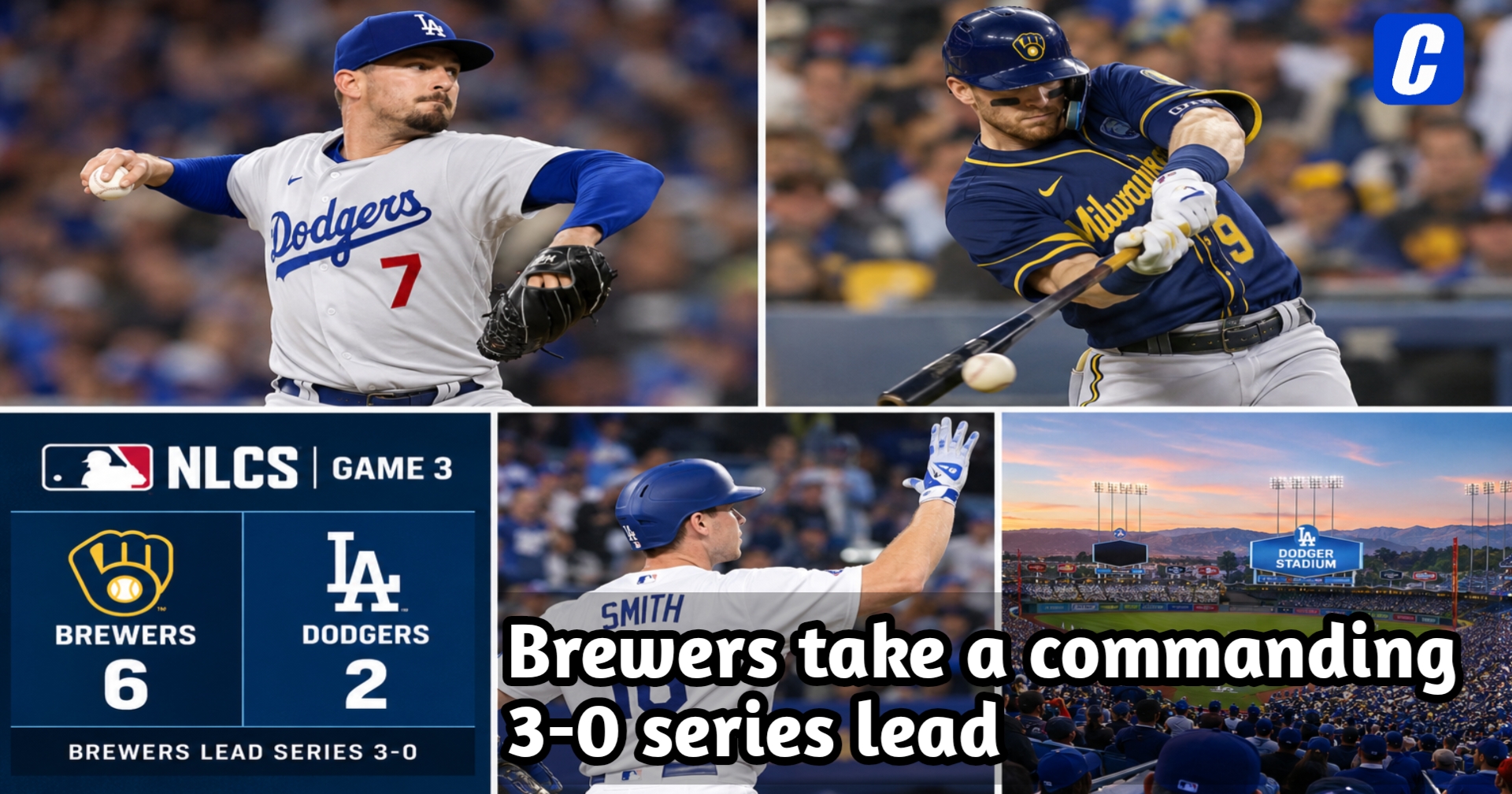
Three homers and a big late-inning response salvaged the night. The final Dodgers score was 6–2 in favor of Milwaukee, leaving the Brewers with a commanding 3–0 lead in the National League Championship Series (NLCS).
For fans following the latest Dodgers news, the result raises an important question: Are the Dodgers still in the playoffs? Yes, they are still alive, but they must win Game 4 to avoid elimination.
Here is how the Brewers vs. Dodgers Game 3 unfolded, which players made the biggest difference, and what to know about the next game.
Dodgers Score Today: Brewers Win Game 3 by 6–2
The Milwaukee Brewers defeated the Los Angeles Dodgers on Wednesday, October 14, at Dodger Stadium. The victory moved Milwaukee within one win of the 2026 World Series.
Final score:
-
Milwaukee Brewers: 6
-
Los Angeles Dodgers: 2
-
NLCS series score: Brewers lead 3–0
Milwaukee had already won the first two games, so this victory put additional pressure on the defending champions. The Dodgers now need four consecutive wins to take the series, while the Brewers need just one more victory to advance.
The biggest difference was Milwaukee’s ability to respond when the Dodgers briefly moved ahead. Los Angeles had a chance to build momentum in the sixth inning, but the Brewers answered with two home runs in the seventh.
Jackson Chourio Gives the Brewers an Early Lead
The Brewers needed only one pitch to make their presence felt.
Jackson Chourio hit a home run on Blake Snell’s opening pitch, immediately giving Milwaukee a 1–0 advantage. It was an early warning that the Dodgers’ starting pitcher would have little room for error.
Snell, however, recovered well. He recorded nine strikeouts and retired 14 consecutive batters at one point, keeping the Brewers from extending their lead for several innings.
On the other side, Milwaukee starter Robert Gasser kept the Dodgers scoreless through five innings. He limited their scoring opportunities and relied on his defense to make important plays.
The pitching matchup made the first half of this MLB game particularly interesting. Both starters gave their teams a chance to win, but Milwaukee eventually found the decisive hits.
Will Smith Gives Los Angeles Hope
The sixth inning offered the Dodgers their best opportunity to change the game.
After Gasser left the mound, Milwaukee’s bullpen struggled with its control. Abner Uribe issued three walks, putting the Brewers in a jam with runners on base.
Will Smith stepped up and delivered the hit Los Angeles desperately needed.
His two-run double into left-center field brought home two runners, giving the Dodgers a 2–1 lead. For a moment, the momentum at Dodger Stadium had completely changed.
The hit was especially important because Los Angeles had struggled to turn scoring opportunities into runs throughout the series.
However, the Dodgers could not extend their advantage. Milwaukee’s relievers limited the damage, leaving the Brewers within striking distance.
That missed opportunity became a major turning point in the Dodgers vs. Brewers Game 3 recap.
Jake Bauers and Garrett Mitchell Change Everything
The seventh inning decided the game.
Andrew Vaughn opened the inning with a walk, ending Snell’s streak of 14 consecutive batters retired. Jake Bauers followed, and what happened next changed the scoreboard.
Bauers battled through an 11-pitch at-bat before hitting a two-run home run. His shot put Milwaukee ahead 3–2 and silenced much of the Dodger Stadium crowd.
Garrett Mitchell followed with another home run, extending the Brewers’ lead to 4–2.
Suddenly, the advantage belonged to Milwaukee.
Bauers’ home run was especially impressive because he refused to give in during a tough at-bat.He didn’t swing at everything, stayed patient, fouled off several pitches, waited for one he could drive.
For Blake Snell and the Dodgers, the back-to-back home runs proved costly. Snell had pitched effectively for much of the night, but the Brewers capitalized on their opportunity when the pressure was highest.
Brewers Add Insurance in the Late Innings
Milwaukee did not allow the Dodgers another opportunity to take control.
In the eighth inning, Brice Turang scored on a wild pitch, increasing the lead to 5–2. Joey Ortiz added another run with an RBI single in the ninth.
The Brewers finished with a 6–2 victory, backed by timely hitting and a strong bullpen performance.
Reliever DL Hall was key in preserving Milwaukee’s lead, and closer Trevor Megill got the final outs.
The Dodgers showed a problem late in the game that has plagued them for a long time: getting on base without enough runs. Will Smith’s double provided a breakthrough, but the offense could not maintain that momentum.
The Milwaukee Brewers vs. Dodgers matchup was ultimately decided by execution. Milwaukee made its scoring opportunities count, while Los Angeles could not do enough after briefly taking the lead.
Dodgers vs Brewers Game 4: Date, Time and Where to Watch
The next matchup is critical for both teams. Game 4 of the NLCS is scheduled for Thursday, October 15, at Dodger Stadium.
Game 4 details:
-
Matchup: Milwaukee Brewers vs. Los Angeles Dodgers
-
Date: Thursday, October 15, 2026, in Los Angeles
-
Time: 5:00 p.m. Pacific Time / 8:00 p.m. Eastern Time
-
US broadcast: FS1, FOX Deportes and FOX One
-
Series situation: Brewers lead 3–0
For viewers in India, the scheduled start corresponds to approximately 5:30 a.m. IST on Friday, October 16. Broadcast availability in India may differ from US coverage.
Fans searching for where to watch Dodgers vs. Milwaukee Brewers should check their local broadcaster or the official MLB postseason schedule for regional viewing options. Game times and broadcast arrangements can change.
What the Dodgers Must Do to Stay in the Playoffs
The Dodgers still have a chance, but the challenge is enormous.
Their first priority is improving their hitting with runners on base. Getting players into scoring position means little if the team cannot deliver the next hit.
They also need their leading hitters to produce more consistently. Players such as Shohei Ohtani, Freddie Freeman and Mookie Betts have the ability to change a game, but Los Angeles needs that production at the right moment.
On the pitching side, Game 3 showed that even a strong performance from Blake Snell may not be enough without sufficient offensive support.
The simplest approach is to focus on one game at a time. Winning Game 4 would keep the series alive and send the teams back to Los Angeles for a potential Game 5.
Frequently Asked Questions
Did the Dodgers win today?
The latest completed game, NLCS Game 3 on October 14, ended in a 6–2 victory for the Milwaukee Brewers. Game 4 is scheduled for October 15 in Los Angeles.
Are the Dodgers still in the playoffs?
Yes. The Dodgers have not been eliminated, but they trail the Brewers 3–0. Another loss would end their postseason run.
How many games are in the NLCS?
The National League Championship Series is a best-of-seven series. The first team to win four games advances to the World Series.
How many games do the Brewers need to win?
Milwaukee needs one more victory to win the NLCS and advance to the 2026 World Series. The Dodgers must win four games in a row to take the series.
Have the Brewers ever won a World Series?
No. The Brewers reached the World Series in 1982 but lost to the St. Louis Cardinals in seven games. They are now one win away from returning to baseball’s championship series for the first time in 44 years.
Final Thoughts
The Dodgers vs. Brewers series has become a test of patience, timing and execution. Milwaukee has repeatedly found the big hit when it matters, while Los Angeles has struggled to turn promising opportunities into sustained offense.
Game 3 showed just how quickly a postseason game can change. Will Smith’s double briefly gave the Dodgers hope, but Jake Bauers and Garrett Mitchell answered with home runs that changed the outcome.
Now, the attention turns to Game 4. The Brewers are close to the World Series, while the Dodgers must win to keep their championship hopes alive.
For MLB fans, the next game could be the defining moment of this NLCS.